Guide
Testing
How Fire Door Inspection Is Carried Out in the UK
UK fire door inspection guide: BS 8214, RRO 2005, what inspectors check & how Certie.co keeps you fully compliant. Free to start today.
Introduction
Fire doors are the single most critical element of passive fire protection in any UK building. A properly maintained fire door can hold back flames and toxic smoke for 30 to 120 minutes — enough time to save lives. But only if they are regularly and correctly inspected.
This guide walks you through exactly how fire door inspections are carried out in the UK, which legislation applies, and how Certie.co makes the entire process paperless and audit-ready.
Why Fire Door Inspections Matter
Fire doors are not ordinary doors. They are engineered, tested, and certified assemblies that must perform to a precise standard under extreme conditions. When a fire breaks out, a correctly functioning fire door compartmentalises the building — buying critical evacuation time and limiting property damage.
A significant proportion of fire doors in UK residential and commercial buildings fail basic compliance checks — often due to:
Missing or damaged intumescent seals
Incorrect gap tolerances around the door
Damaged door frames or hinges
Propped-open doors
Missing self-closing devices
Absence of certification labels
These failures are entirely preventable through regular, documented inspection.
Legal Requirements & Legislation
Fire door inspections in the UK are governed by the following key legislation:
Regulatory Reform (Fire Safety) Order 2005 (RRO) The primary legislation placing legal responsibility on the "responsible person" — building owner, employer, or managing agent — to ensure fire doors are maintained in effective working order. Non-compliance can result in unlimited fines or imprisonment.
Fire Safety Act 2021 Clarified that the structure, external walls, and flat entrance doors of multi-occupied residential buildings fall within the scope of the RRO. This was a direct legislative response to the findings of the Grenfell Tower fire inquiry.
Fire Safety (England) Regulations 2022 Came into force on 23 January 2023. Introduced specific mandatory inspection frequencies for residential buildings — making documented inspections a legal obligation, not merely best practice.
BS 8214:2016 — Fire Door Assemblies The British Standard providing the technical code of practice for the installation and maintenance of fire door assemblies. Covers gap tolerances, ironmongery, seals, signage, and certification requirements.
Approved Document B (Building Regulations) Specifies where fire doors must be installed and to what fire resistance rating (FD30, FD60, FD90, FD120).
Who Can Carry Out a Fire Door Inspection?
A competent fire door inspector in the UK typically holds one or more of the following qualifications:
FDIS — Fire Door Inspection Scheme (the most widely recognised qualification in the UK)
BWF-CERTIFIRE Scheme — British Woodworking Federation
IFC SDI 122 — Certified Door Inspector qualification
ASFP — Association for Specialist Fire Protection training
GAI — Guild of Architectural Ironmongery certification
For basic visual checks in residential buildings, a trained housing officer or building manager may carry out routine checks. However, formal technical inspections must always be undertaken by a qualified professional.
How Often Should Fire Doors Be Inspected?
Building Type | Door Type | Required Frequency |
|---|---|---|
High-rise residential (18m+) | Flat entrance doors | Every 3 months |
Mid-rise residential (11–18m) | Flat entrance doors | Every 3 months |
All multi-occupied residential | Communal fire doors | Every 12 months |
Commercial / workplace | All fire doors | Annually (or per fire risk assessment) |
Hospitals / care homes / schools | All fire doors | Every 6 months |
Any building post-incident or post-works | All affected fire doors | Immediately |
Step-by-Step: How a Fire Door Inspection Is Carried Out in the UK
Step 1 — Pre-Inspection Documentation Review
The inspector reviews all available documentation — original certification, installation records, previous inspection reports, and any remedial action records. Without documented evidence of origin, a fire door cannot be assumed to be compliant.
Step 2 — Check the Door Leaf Identification Label
Every certified fire door should carry a permanent identification label on its top edge. The inspector checks for a plug, label, or sticker confirming the door's fire rating (FD30, FD60 etc.), manufacturer, and third-party certification body such as BWF-CERTIFIRE, Exova, or Warringtonfire.
Step 3 — Inspect the Door Frame & Structural Fixings
The frame must be correctly secured to the wall construction with appropriate fixings. The inspector checks for movement, cracking, splits, or signs of damage. A loose or damaged frame invalidates the entire fire door assembly regardless of the condition of the door leaf.
Step 4 — Measure Gaps Around the Door
Using a calibrated gap gauge, the inspector measures the clearance gap around the door leaf. Per BS 8214, the permitted gap is:
2–4mm on the top and both sides
Up to 8mm at the bottom threshold
Any deviation is recorded as a defect requiring remediation.
Step 5 — Inspect Intumescent Seals & Smoke Seals
Intumescent seals expand upon exposure to heat in order to block gaps. Smoke seals prevent the passage of cold smoke. The inspector checks that seals are:
Present on all sides
Continuous with no breaks or missing sections
Correctly fitted within the rebate groove
Undamaged and not painted over
Missing or damaged seals are a critical defect requiring immediate remediation.
Step 6 — Test the Self-Closing Device
Fire doors must be self-closing and positive-latching under all conditions. The inspector holds the door at 5°, 45°, and 70° open positions and releases it — the door must close fully and latch from all positions without manual assistance.
Any hold-open device must be a certified electromagnetic type linked to the fire alarm system — never a wedge, hook, or chain.
Step 7 — Check Ironmongery, Hinges & Fixings
Fire-rated hinges must be securely fixed with no missing, loose, or corroded screws. Locks, latches, handles, letter plates, overhead closers, and vision panels are each checked for correct certification and condition.
Unapproved ironmongery can invalidate a fire door assembly's rating entirely.
Step 8 — Inspect the Door Leaf for Damage
The inspector checks both faces and all edges of the door leaf for:
Holes, cracks, or splits
Warping or delamination
Water damage
Unauthorised penetrations (cable runs, cat flaps, drill holes)
Even minor penetrations through a fire door leaf represent a critical defect.
Step 9 — Glazing & Vision Panel Inspection
Where vision panels are present, the inspector verifies that fire-rated glass (Georgian wired, borosilicate, or ceramic) is correctly installed with appropriate intumescent glazing seals and beading, as specified in the door's certification evidence.
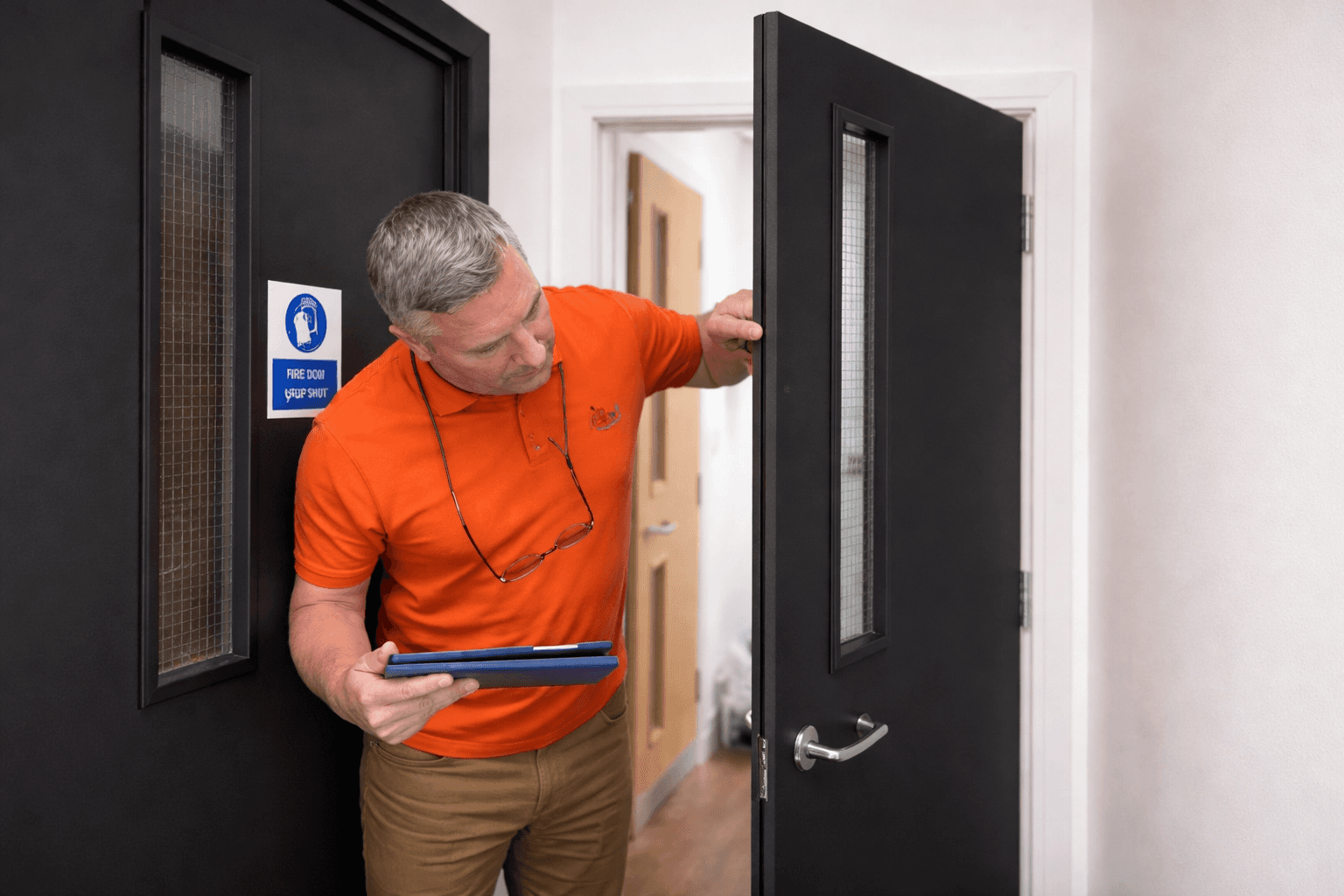
Step 10 — Signage Check
Fire doors must display:
"FIRE DOOR KEEP SHUT" on both sides, or
"FIRE DOOR KEEP LOCKED" where applicable
The inspector checks for presence, legibility, and correct positioning in accordance with BS 5499 and the Health & Safety (Safety Signs and Signals) Regulations 1996.
Step 11 — Record, Report & Issue Certificate
The inspector records all findings — pass, advisory, or fail — for every element of the assembly. A formal written report is produced including:
All defects identified
Photographic evidence
Recommended remediation actions
Urgency classifications (advisory / urgent / critical)
Re-inspection timescales
This record must be retained as part of the building's fire safety documentation.
Fire Door Inspection Checklist (UK)
Identification label present and legible on the top edge of the door leaf
Third-party certification evidence available
Frame securely fixed — no movement, cracking, or damage
Gap of 2–4mm around three sides; up to 8mm at the threshold
Intumescent seals present, continuous, and undamaged on all sides
Smoke seals present and intact where specified
Self-closer operates correctly from 5°, 45°, and 70° open positions
Door latches positively under all conditions
All hinges fire-rated, fully screwed, and free from corrosion
All ironmongery fire-certified (locks, handles, letter plates)
Door leaf free from holes, cracks, warping, or penetrations
Glazing is fire-rated with correct intumescent seals and beading
Signage present and legible on both sides
No unauthorised hold-open devices (wedges, hooks, chains)
Inspection record produced and provided to the responsible person
How Certie.co Simplifies Fire Door Inspection in the UK
Certie.co is a purpose-built digital platform that transforms fire door compliance from a paper-heavy burden into a fully digital, auditable workflow — designed specifically for UK responsible persons, fire safety consultants, and property managers.
📱 Mobile-First Inspection App
The Certie app guides your inspector through every element of the BS 8214-aligned checklist, step by step, with photo capture at each stage. Works fully offline on site — syncs automatically once back online.
📄 Instant Digital Certificates
The moment an inspection is submitted, Certie.co automatically generates a professional PDF certificate for each fire door — complete with findings, photographs, inspector details, and a unique reference number.
🏢 Portfolio Management
Manage entire building portfolios from a single dashboard. Ideal for housing associations, facilities management companies, and fire safety consultancies operating across multiple sites.
🔔 Automated Re-Inspection Reminders
Certie.co automatically schedules the next inspection based on building type and regulatory requirements — quarterly, bi-annually, or annually — and sends reminders to both inspectors and property managers well in advance.
🔒 Audit-Ready Cloud Records
Every inspection, photograph, defect, and remediation action is stored securely in the cloud — always accessible for enforcement authorities, insurance audits, or legal proceedings.
✅ Fully Aligned with UK Legislation
Certie.co is built around the Fire Safety (England) Regulations 2022, RRO 2005, and BS 8214 — so you remain fully compliant with the latest UK requirements at all times.
👉 Start your free account at certie.co
Explore
Discover expert insights, tips, and updates on property compliance, safety regulations, and best practices to keep your properties secure and compliant.