Updates
Basics
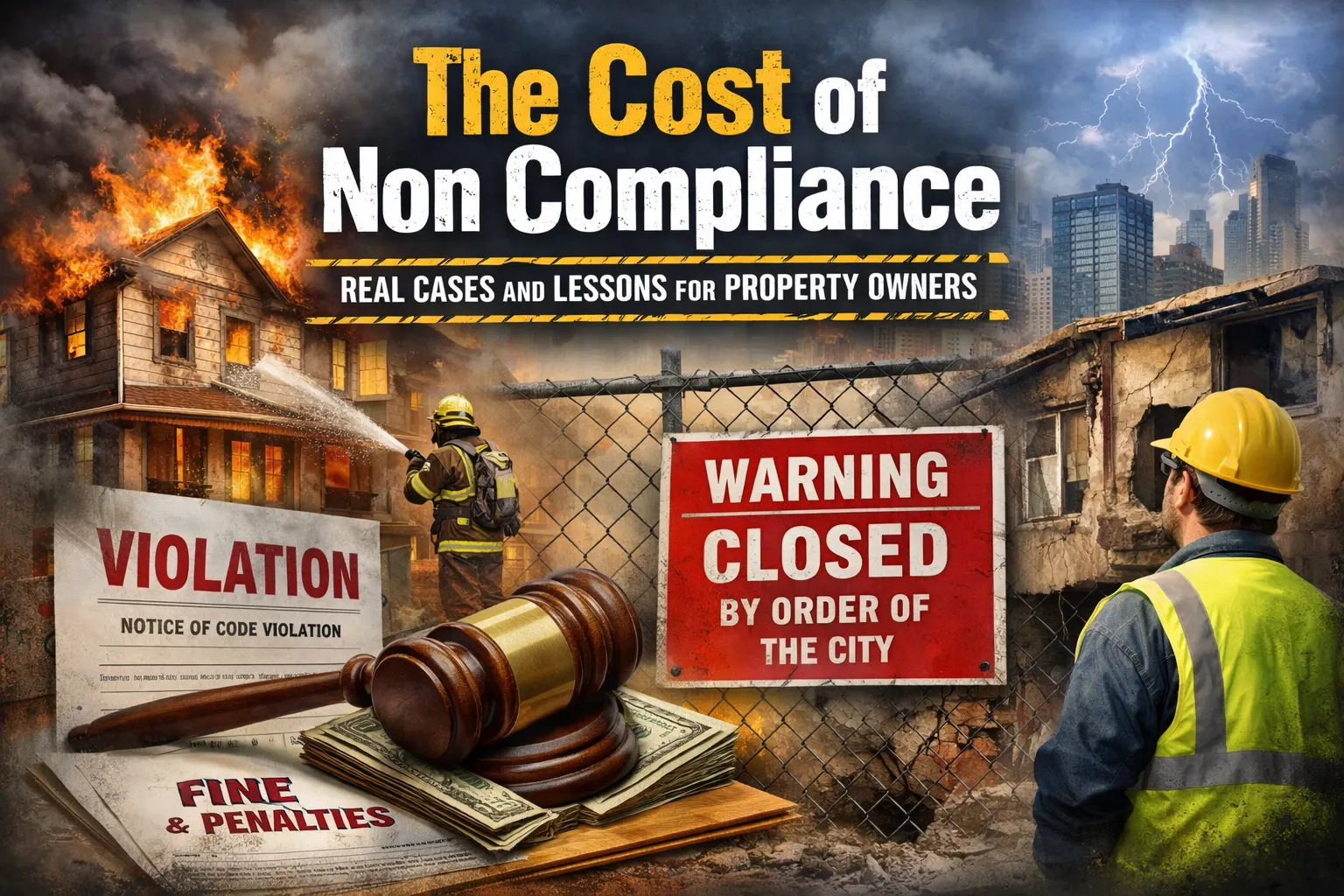
The cost of non compliance: real cases and lessons for property owners.
Real cases showing the financial and legal consequences of property safety non-compliance for UK landlords.
The cost of non compliance: real cases and lessons for property owners
The penalties for non-compliance hit property owners way beyond just paying fines. Owners who don't follow the rules face tough consequences - from hefty fines to criminal charges and jail time. Most landlords don't realise how bad things can get until they're staring down legal trouble.
Over the last several years helping property owners, we've watched property compliance penalties UK wreck both businesses and personal bank accounts. Legal fallout from non-compliance blindsides landlords, especially when they have tried to save money by cutting corners. The harsh reality tells a different story.
Safety regulations protect real lives - they're not just rules to avoid getting fined. The sort of thing I love about real cases is that they show this truth crystal clear. This piece dives into actual incidents where property owners faced serious consequences. We'll see what went wrong and learn valuable lessons from these cautionary stories.
The true meaning of non-compliance for property owners
Property owners can't just brush off non-compliance as a simple oversight. It shows you haven't met your legal obligations for property rental or management. Every landlord needs to know what this means in real terms to stay protected and successful.
What is considered non-compliance?
You're non-compliant any time you fail to meet your legal responsibilities as a property owner. This might be something that seems small, like letting a safety certificate expire, or something bigger like running an unlicensed House in Multiple Occupation (HMO).
Landlords don't always mean to be non-compliant. Your gas safety certificate might expire while you're on vacation. Maybe that Energy Performance Certificate (EPC) is still sitting in your drafts, or you haven't finished the deposit protection paperwork. All the same, you'll face the same consequences whatever your intentions were.
The biggest problem with non-compliance is that your property could be perfectly safe and your tenants happy, yet you might still be breaking the law [1]. Many landlords fall into this trap. They think everything's fine until enforcement action starts.
The private rental sector has to follow 178 pieces of legislation [2]. You need to navigate the Regulatory Reform (Fire Safety) Order 2005, gas safety regulations, electrical safety standards, deposit protection schemes, and tenancy documentation requirements. Following these compliance rules isn't just a good idea—you have no choice.
Common areas of property compliance failure
Property owners keep stumbling over certain compliance areas, even with good intentions:
Safety certificates and checks: Most failures happen with expired gas safety certificates, missing Electrical Installation Condition Reports (EICRs), and poor fire safety measures.
Documentation issues: Landlords often fail to give required tenancy information, miss the 30-day window to protect deposits in government-approved schemes, or don't meet prescribed information deadlines.
Licencing requirements: Many landlords don't realise their property needs specific licences until enforcement officers show up at their door.
Regulatory changes: Safety standards and building regulations keep changing. Staying current with requirements can be tough, but missing any requirement could land you in serious trouble.
One compliance failure often triggers others. A gas certificate that expires doesn't just break safety rules - it also invalidates your insurance and stops you from legally serving a Section 21 eviction notice.
Why compliance matters beyond the law
Compliance means more than just avoiding fines and legal trouble. It saves lives first and foremost. You help prevent accidents, injuries, and emergencies by following safety regulations and industry standards.
Your investment stays protected when you follow the rules. Non-compliance could void your building's insurance and leave you exposed to huge financial losses.. If something goes wrong because you skipped required checks - like a gas leak - your policy probably won't cover the damage.
Your reputation takes a hit too. Non-compliance issues can destroy an organisation's standing and lead to lost business. Bad tenant reviews and negative word-of-mouth can devastate you in today's market.
Compliance helps create fairness and equality in the rental sector. Landlords who follow legal standards and ethical practises protect their tenants from exploitation, discrimination, and unfair treatment. This gives everyone access to safe, decent, and affordable housing.
A compliant property business runs more smoothly. You'll have fewer disputes, better tenancies, stronger legal protection if problems come up, and real peace of mind about your investment. Nobody wants to lie awake worrying about enforcement action - that's no way to run a property business.
Legal and financial penalties landlords face
Landlords who don't follow property regulations can face harsh money penalties and legal trouble. These penalties can wreck both personal finances and business operations, and many property owners don't see them coming.
Fines for landlords in the UK
The UK has made money penalties much tougher over the last several years. The Renters' Rights Act created a two-tier system for penalties:
Standard breaches can cost up to £7,000 for original or minor violations [6]
Serious or repeated offences might lead to penalties up to £40,000 [6]
Local authorities now have strong powers to enforce rules with clear penalty guidelines. To name just one example, landlords who don't give required tenancy information usually pay £2,500, while those offering fixed-term tenancies (which aren't allowed anymore) start at £4,000 . The penalties get bigger for misusing possession grounds - like lying about plans to sell - with fines between £15,000 and £25,000.
Councils can give multiple fines for different violations in a landlord's properties. These civil penalties work like parking tickets - councils don't need court hearings to issue them, but landlords can still defend themselves in writing.
Criminal charges and prosecution
Money penalties aren't the only worry. Bad safety violations, especially those that hurt or kill someone, can lead to criminal charges. Landlords in these cases might face unlimited fines or jail time.
Local housing authorities get to pick between giving civil penalties or going after criminal charges [11]. They can't do both for the same violation - the law doesn't allow it. The proof needed for civil penalties matches criminal cases: "beyond reasonable doubt".
A criminal record does more than just hurt your wallet. It makes future business deals, mortgage applications, and your reputation in the community much harder.
Impact on insurance and liability
Breaking the rules often voids a landlord's insurance policies, leaving them open to big financial risks. Insurance companies might:
Refuse to cover claims if rule-breaking led to damage or injury
Cancel policies because of negligence
Make landlords pay for tenant injuries, which can mean expensive lawsuits
Landlords might also have to pay compensation for medical costs and damages if tenants or visitors get hurt due to safety problems. This stays true whether criminal charges happen or not.
A really bad situation happens when tenants report problems and landlords ignore them. Insurance companies will probably reject any claims that come up, and landlords end up paying huge costs themselves.
Loss of rental income or eviction bans
Rent Repayment Orders (RROs) can hit landlords' wallets hard by making them give back up to 12 months of rent to tenants [15]. New changes might push this to 24 months, which could bankrupt many property owners.
Rule-breaking can also stop landlords from getting rid of problem tenants. Some violations make it impossible to serve legal eviction notices. This creates a nasty double hit: a big fine plus keeping a non-paying tenant in the property.
The numbers tell the story - rent repayment orders keep going up each year, jumping from 73 in 2018 to 349 in 2020. Tower Hamlets council alone has helped tenants get back over £1 million through RROs.
Breaking certain rules can also get landlords banned from renting property and put on the Rogue Landlord Database - which basically ends their business for good.
Real cases of landlord non-compliance in the UK
Ground examples show the harsh reality property owners face when they ignore their compliance obligations. These cases show real financial and legal consequences that UK landlords have faced over the last several years.
Case 1: Fire safety negligence
Eurolets (UK) Limited, a property management company, faced crushing penalties after fire safety inspections showed serious problems in their five-storey building with more than 40 self-contained flats. Inspectors found combustible materials near entrances, missing fire extinguishers and signage, doors wedged open, holes in walls, and broken fire alarms.
The company fixed these issues after getting their original Enforcement Notice. Yet a later inspection showed the same problems had come back. The judge stressed that these failures created a situation where "if a fire had started, there was a risk of an uncontrolled spread of heat, smoke and flames affecting the whole premises".
Eurolets paid a heavy price - £80,170 in total, which included a £60,000 fine, victim surcharge, and £20,000 in costs. The judge made the fine bigger because the company's negligence put many residents at risk.
Case 2: Gas safety certificate failure
A landlord learned the hard way that missing a gas safety check deadline could lead to serious trouble. The landlord installed a new boiler right after tenants moved in but failed to get proper Gas Safety Certificates and give them to tenants.
The landlord's attempt to evict tenants using a Section 21 notice failed. The court ruled against it because tenants never got copies of the Building Regulations Compliance Certificate or Gas Safety Certificate. This Hastings County Court case from December 2023 made it clear that new boiler installations need quick documentation.
The failed eviction wasn't the only problem. Running a rental property without current gas safety checks breaks the law. Landlords can face fines up to £6,000 for each breach and jail time in serious cases.
Case 3: Ignoring electrical safety checks
A landlord got hit with a big £14,000 fine for breaking Electrical Safety Regulations in England. These rules say qualified electricians must check electrical installations every five years. They must produce an Electrical Installation Condition Report (EICR) and fix problems within 28 days if they find any.
Local councils can fine landlords up to £30,000 for each breach of electrical safety rules. They can also arrange repairs themselves if landlords don't act and make the property owner pay later.
Case 4: Unlicensed HMO operation
A Preston landlord faced serious punishment for running an unlicensed House in Multiple Occupation (HMO). Mr. Liang Chen admitted to four regulation breaches. He failed to make a proper fire risk assessment and ignored a prohibition notice.
Fire safety officers told him the building wasn't safe for sleeping because it lacked proper fire alarm systems and escape routes. They were shocked to find tenants still living there during a follow-up check.
The court gave Mr. Chen a nine-month suspended prison sentence, 120 hours of community service, and ordered him to pay £2,400 in costs.Unlicensed HMO operators can face unlimited fines, must repay up to 12 months of collected rent, and might get banned from being landlords.
These landlords also can't serve valid Section 21 notices to evict tenants while their HMO stays unlicensed. This restriction stays until they get proper licencing.
The hidden costs of non-compliance
Property non-compliance comes with hidden costs that go well beyond direct fines and penalties. These unexpected expenses usually increase the effects of regulatory breaches and continue to affect landlords long after addressing the original violation.
Reputational damage
Bad publicity about compliance failures can severely damage a property owner's reputation. Trust means everything to property owners—and rebuilding it after a loss becomes incredibly hard. Public records and media coverage create permanent links between companies, directors, and their compliance failures. This damages their credibility with investors, tenants, and business partners.
Word-of-mouth recommendations drive this industry's business, and negative publicity from compliance breaches can follow landlords for years. These reputation issues make it harder to:
Attract new tenants
Renew existing contracts
Maintain positive relationships with letting agents
Secure financing for future property investments
One industry expert points out, "Letting agents who don't keep up with compliance don't only risk financial penalties—they risk losing trust, clients, and knowing how to trade". Individual landlords face the same risks, as a single compliance failure can permanently damage their standing in the local rental market.
Legal fees and court costs
Legal proceedings often cost much more than the original penalties. Simple compliance disputes can turn into expensive legal battles with uncertain outcomes. A basic dispute about a missing safety check could become a long case needing specialist lawyers.
Legal battles create major business disruptions. They waste management time and resources that could help improve properties or grow the business. Property owners dealing with investigations usually face:
Weeks filled with stress, paperwork, and wasted time
Management focusing only on violation issues
Broader regulatory reviews that go beyond the original complaint
Lost revenue from contract cancellations and supplier departures
Landlords often underestimate these indirect costs. Industry analysis shows that operational disruptions and legal expenses typically cost several times more than the actual penalties.
Tenant compensation claims
ow better understand their rights to claim compensation for disrepair and non-compliance issues.
Records from 70 English councils show nearly 17,000 disrepair claims filed over five years, with payouts exceeding £55.1 million. This number likely represents just a portion of total compensation, since about 100 councils didn't provide data.
Compensation amounts depend on:
The compliance failure's severity
How long the issue lasted
The issue's effect on tenants' lives
Calculations usually range from 25-50% of rent during the problem period. A property with faulty wiring renting for £1,500 monthly over six months could lead to £2,250 in tenant compensation at a 25% rate.
Increased scrutiny from local councils
Local authorities watch non-compliant landlords more closely, which creates ongoing challenges. This increased oversight usually leads to:
More property inspections
Extra documentation needs
Closer reviews of your entire portfolio
Regular checks of property management practises
Lambeth Council provides a good example. Their serious procurement and contract management problems exposed them to major financial and legal risks. This applies to landlords too—one compliance failure often triggers detailed reviews of all properties and systems.
The cost of non-compliance reaches far beyond immediate penalties. Reputation damage, legal costs, tenant claims, and increased oversight create expenses that far exceed the original fine. Property owners save more money by preventing issues rather than fixing them later.
How to avoid non-compliance as a landlord
It's better to prevent non-compliance than deal with its consequences. Smart property management helps landlords avoid fines and keeps tenants safe. Let's look at some proven ways to stay compliant with regulations.
Regular property inspections
Regular checks are the foundations of good compliance management. Leading property experts suggest inspections every three to six months. The first check after three months of a new tenancy is vital. It helps set clear expectations and spots any early issues.
Your inspections should cover these three areas:
Statutory checks (smoke alarms, CO detectors, electrical safety)
General property condition (damp, structural issues, appliance functionality)
Potential tenancy breaches (unauthorised alterations, subletting) [25]
Note that you must give at least 48 hours' written notice before any inspection to respect your tenants' right to quiet enjoyment [24].
Staying updated with property compliance laws UK
Property rules change often, so staying informed is essential. Here's what works:
You should subscribe to updates from Gov.uk and your local authority websites. Membership in landlord associations like the National Residential Landlords Association (NRLA) gives you access to great resources, legal updates and support. Industry leaders on social media platforms can give you immediate updates about new compliance requirements.
Review your entire portfolio's compliance annually to spot any gaps in your documentation.
Working with certified professionals
Qualified professionals should handle all safety inspections and maintenance work. Your contractors need proper accreditation - Gas Safe registration for gas work, NICEIC qualification for electrical inspections.
A professional letting agent who belongs to industry bodies like ARLA, RICS, or UKALA can be helpful. These agents get regular training on rule changes and can handle much of the legal work.
Using property management software
The right software can protect you from missing important compliance deadlines. Good systems offer:
Automated certificate renewal reminders
Centralised document storage
Compliance status dashboards with RAG (Red/Amber/Green) indicators
Mobile access to critical documentation
Platforms like Certie.co can track gas safety, electrical checks and fire safety compliance while managing tenancy details in one place. You'll get audit-ready logs with timestamps and user trails - exactly what councils look for when they ask for information.
Cost of compliance vs non-compliance
Property owners need to weigh their compliance investments against the much higher costs of breaking the rules. Research shows that non-compliance costs 2.7x more than taking proactive compliance measures.
Original investment in compliance
Compliance costs upfront include training, audits, software systems, and professional certifications. Smart landlords keep at least six months of expenses available in savings before they buy investment properties. This financial cushion helps them maintain properties properly, renew certificates on time, and address tenant needs without money worries.
Long-term savings from avoiding penalties
The numbers make a strong business case. Here are some potential penalties to think about:
Energy Performance Certificate failures: £5,000 per property
Gas safety violations: up to £6,000 plus possible jail time
Electrical safety breaches: up to £30,000 in civil penalties
Deposit protection failures: up to 3x the deposit amount
Non-compliance does more than just lead to fines. It disrupts operations, creates expensive legal issues, and damages a business's reputation for years.
Peace of mind and tenant satisfaction
Compliance plays a direct role in tenant satisfaction scores. The data shows that compliant landlords get higher ratings in overall service delivery, safety perceptions, and fair treatment. In spite of that, only 25% of organisations put effective action plans in place based on tenant feedback. Companies that do take action provide better service and build stronger relationships with tenants—which might be compliance's most valuable benefit beyond the financial aspects.
Conclusion
This piece shows how non-compliance can wreck property owners' finances, legal standing, and professional reputation. The risks go way beyond simple fines. Serious offences can lead to £40,000 penalties and jail time in extreme cases. Of course, real-life examples show that cutting corners ended up costing by a lot more than proper compliance investment.
Property owners should know that compliance isn't just about checking boxes to dodge penalties. It's a core duty to keep tenants safe and healthy. The numbers tell the story - non-compliance costs 2.7 times more than staying ahead with compliance measures.
The hidden costs can hurt more than the original penalties. A landlord's damaged reputation can last for years. Tenant compensation claims, legal fees, and extra attention from local authorities create ongoing money problems. These issues affect every part of property management and hurt future business chances and tenant relationships.
Regular inspections, updated regulation knowledge, certified professional partnerships, and property management software give the best shield against expensive mistakes. This approach might get pricey at first, but it brings peace of mind and stable finances over time.
Compliance builds a strong foundation for successful property management. Nobody wants to constantly worry about enforcement action - it defeats the purpose of property investment. Landlords who make compliance their priority protect themselves legally. They also build better tenant relationships, keep property values high, and create business models that can handle regulatory checks.
The decision between following rules or not isn't really a choice. The evidence clearly shows that compliance is both the right thing to do and makes the most business sense for every responsible property owner.
Explore
Discover expert insights, tips, and updates on property compliance, safety regulations, and best practices to keep your properties secure and compliant.