Property Management
Basics
Fire Door Checks and Inspections: What Landlords and Managers Must Know
Understand UK fire door inspection rules, including legal duties, safety checks, and compliance requirements for landlords.
Keywords
fire door checks UK
fire door inspection requirements
fire door compliance for landlords
how to check fire doors
fire door safety regulations UK
landlord fire door responsibilities
fire door maintenance checklist
fire door inspection frequency
fire door regulations for rental properties
fire door safety for property managers
what to look for when checking fire doors
fire safety compliance for landlords
what landlords need to know about fire door checks
how often should fire doors be inspected UK
fire door checks for HMOs and rental buildings
fire door compliance guide for property managers
fire door inspection steps and legal duties
best fire door compliance software UK
who can carry out fire door inspections UK
Fire Door Checks and Inspections: What Landlords and Managers Must Know
The UK's fire safety landscape changed dramatically when the Fire Safety (England) Regulations 2022 took effect on January 23, 2023. These new rules have transformed fire door inspections completely. Property managers and landlords now face strict requirements. They must check fire doors in communal areas every three months and conduct a fire door inspection of flat entrance doors yearly.
Many professionals still feel unsure about what these regulations mean for them. We're property managers too, and we know how challenging compliance can be, especially when you have buildings over 11 metres with extra requirements. Missing these fire door compliance checks isn't just paperwork gone wrong - it's a criminal offence. Landlords could face financial penalties up to £5,000 for each violation. These rules came about for good reason. The Grenfell Tower Inquiry revealed how failing fire doors let smoke and gas spread throughout the building.
Let us guide you through everything about fire door checks in the UK. You'll learn your legal obligations as a landlord and get practical ways to inspect doors that keep your tenants safe while staying compliant with the law.
Fire doors need regular inspections to keep buildings safe. These life-saving barriers deserve the same attention as smoke alarms and fire extinguisher pressure checks. Let's get into the significant elements you need to check during inspections.
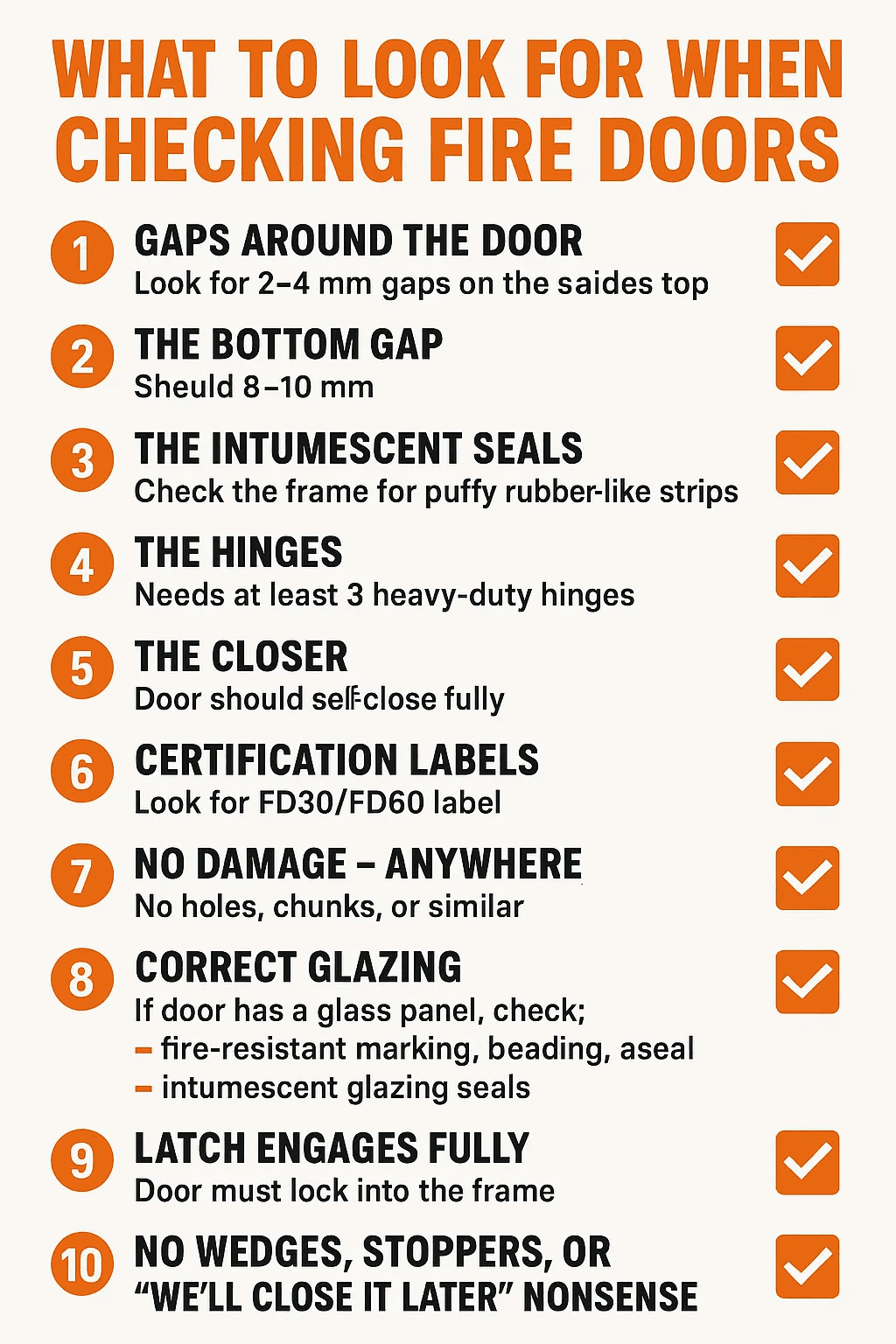
What to look for when checking fire doors
Start by confirming if your door is fire-rated. A certification label or coloured plug sits on the door's top edge. You can use your phone's selfie mode to spot this hard-to-see area .
Take a good look at the door and frame. Search for visible damage that might affect fire resistance. The door should sit flush against the doorstop without any warping between the stiles, top, and frame.
Glass panels need careful inspection. A cracked or broken glass needs immediate replacement because smoke and gases can slip through these openings during a fire . Only trained professionals should handle replacements using proper fire-resistant materials.
Note that unauthorized changes can compromise your door's safety. Adding a letterbox or switching ironmongery without approval puts the door's integrity at risk .
Smoke seals and fire door gaps
Your fire door's effectiveness depends on its gaps. A gap gauge helps verify spaces between door and frame measure 2mm to 4mm on all sides . This is a big deal as it means that gaps over 4mm let smoke and fire spread, reducing protection.
Look closely at intumescent strips and smoke seals if your door has them. These parts block smoke and stop fire from crossing gaps. They should fit snugly around the door or frame without damage. Check for cracks or tears and make sure the fin/brush remains intact .
Older doors built to earlier standards might not have intumescent strips or smoke seals. Based on fire risk assessment, these doors might still work fine .
Self-closing devices and hinges
Your fire door needs at least three correctly fitted hinges .Each hinge should have all screws in place, CE marking, and fire rating matching the door leaf standards. A Certifire logo usually shows that a hinge meets fire rating requirements .
The self-closing device needs these checks:
Open the door fully - it should close without catching the floor
Open it to 5 degrees (or 75mm) - verify full closure past any latch or seal
From 90 degrees, the door should close in about 10 seconds
The door shouldn't slam
Look for damage or leaks on the closer. Make sure it's firmly attached to both door and frame. The door must 'latch shut' when closing so intumescent seals can work during a fire .
Fire door maintenance checklist
Building type and door usage determine how often you need inspections. Common area fire doors in multi-occupied residential buildings over 11 metres need quarterly checks. Flat entrance doors need annual inspections.
Your inspection records should include:
Location (floor, door, door type)
Frame and door leaf condition
Letterbox functionality
Glazing integrity
Hinges and ironmongery condition
Gap measurements
Strips and seals condition
Self-closer operation
Changes or damage
Create an action plan for each problem. List the fix, timeline, and who's responsible .Keep these records to show you're following regulations.
High-traffic areas need more frequent door checks as wear shows up faster . Doors that see heavy use might need weekly inspections . Good records help track maintenance history, spot recurring issues, and prove you meet regulations.
Handling Access and Tenant Communication
Fire door inspections face a major challenge - getting tenants to provide access. Even the best planning can run into resistance, confusion, or scheduling conflicts. You need good communication strategies to stay compliant.
What to do if tenants refuse access
A tenant's refusal doesn't always mean they won't allow fire door checks. Many just need a different time that works better for them. The best approach is to give them several appointment options that fit different schedules.
If a tenant keeps refusing access, send them a written explanation of the safety risks. Make these points clear:
Inspections keep them and their neighbours safe
They might have to pay for appointments they cancel
They could be responsible if someone gets hurt due to unchecked faults
Their tenancy could be at risk if they don't comply
Some tenants still won't budge. You'll need to take it up a level and ask your local environmental health department or the Health and Safety Executive to step in . As a final option, you can take legal steps:
Get an injunction for access
Issue a Section 21 notice seeking possession
Take Section 8, Ground 12 court action for fixed-term tenancies
Best endeavours and documentation
The Fire Safety Regulations say you must make "best endeavours" to check flat entrance doors yearly. This legal term means you should try every reasonable way to get access before jumping to legal action.
Keep detailed records. You need to track:
Every message you send tenants about access
When you tried to inspect
Why tenants said no
How you tried to work with residents' concerns.
These records prove you tried to comply if anyone asks questions later. Leasehold properties might need updated lease agreements that spell out the right to access for fire safety inspections.
Providing fire safety information to residents
Residents need specific fire safety information. Tell them:
Fire doors must stay closed unless someone's using them
Nobody should mess with self-closing devices
Report damage or problems right away.
New residents should get this information when they move in. Everyone needs a reminder at least once every 12 months. The rules are clear - you must send these yearly reminders to all tenants, new or old .
Buildings with multiple occupants need visible fire safety instructions in communal areas. These should explain how to evacuate, report fires, and what to do in emergencies.
Fire safety education helps get tenants on board. Simple visual guides and quick info sessions are a great way to get residents to understand why fire doors matter for protecting lives and property.
Avoiding Penalties and Staying Compliant
Fire doors need proper maintenance. This isn't just about following best practices - it's a legal requirement that carries serious penalties if ignored.
Fire door compliance for landlords
The Fire Safety (England) Regulations 2022 requires landlords to check fire doors quarterly in communal areas. They must also inspect flat entrance doors yearly in buildings where the top storey is higher than 11 metres. The "Responsible Person" handles these duties - usually the building owner, employer or property manager.
The Regulatory Reform (Fire Safety) Order 2005, Article 17, makes it clear. All fire doors need "a suitable system of maintenance" and must stay "in efficient working order and in good repair" . You'll need to keep detailed records of inspections and maintenance work to prove compliance.
Consequences of non-compliance
Non-compliance can hit your wallet hard. Small violations could cost you up to £5,000 in fines . Serious offences bring unlimited fines and you might face up to two years imprisonment . The average fine since Grenfell has jumped to £27,519 - that's 35% more than the 2014-2019 average.
Money isn't the only thing at stake. You could face prohibition notices that limit building use , get a criminal record , and your insurance policies might become void . Your reputation could take a hit that lasts well beyond any penalties .
Tips for ongoing fire door maintenance
Here's how to stay compliant:
Set up regular inspections - weekly for busy areas and quarterly for normal-use doors
Let qualified people handle inspections - getting FDIS certification is a smart move
Document everything - keep inspection logs, repair reports and certification papers
Teach building users about fire door safety - stress that doors should stay closed
Fix problems quickly - small repairs can be done internally, but major fixes need certified contractors
A detailed inventory of your property's fire doors helps too. List their locations, types, and required performance ratings. This record makes inspections easier and helps track maintenance history effectively.
Conclusion
Fire door checks mean more than just ticking regulatory boxes. They are vital safeguards that protect lives and property. In this piece, you'll learn how proper maintenance is a vital part of making sure these safety barriers work when emergencies happen.
Property managers and landlords need to know their legal duties and how to maintain fire doors properly. These regular inspections should be part of your normal property management routine, following the quarterly and annual schedules we discussed earlier.
People often misunderstand what makes a door compliant, especially when it comes to notional versus certified doors. Note that old doors can stay in place without expensive replacements if they're not damaged and keep the right gap measurements.
You can stay compliant by following our step-by-step inspection process. It also helps to document all checks, whatever the outcome. This protects you from potential penalties and shows your steadfast dedication to tenant safety.
Dealing with tenant access needs a careful touch. You might face some pushback, but explaining the safety aspects usually helps overcome any objections. You need to be willing to keep trying and document your attempts to arrange inspections.
Non-compliance penalties can hit hard, both money-wise and reputation-wise. Looking at fire door maintenance as a safety investment rather than a burden gives you a better point of view. Being proactive costs nowhere near as much as fixing problems after they happen.
We know these regulations can be tough for property professionals. All the same, taking an all-encompassing approach to fire door maintenance protects your tenants and property. It also guards against substantial legal and financial risks. Fire safety is everyone's job—landlords who welcome this fact protect both lives and businesses.
Key Takeaways
Understanding fire door compliance protects both tenant safety and your business from severe penalties whilst avoiding costly unnecessary replacements.
Quarterly checks of communal fire doors and annual flat entrance door inspections are mandatory for buildings over 11 metres high • Not all existing doors need replacing—older "notional" fire doors often remain compliant if undamaged with proper gaps (2-4mm around frame) • Document all inspection attempts meticulously, especially tenant access refusals, as "best endeavours" evidence protects against penalties up to £5,000 • Focus inspections on critical elements: door gaps, self-closing mechanisms, intumescent seals, and hinge integrity rather than seeking unnecessary certifications • Provide annual fire safety information to all residents and maintain comprehensive maintenance records to demonstrate ongoing compliance efforts
Remember that fire door maintenance is fundamentally about protecting lives, not just meeting regulations. A systematic approach to inspections and clear tenant communication creates safer buildings whilst safeguarding your property investment from both legal risks and potential tragedy.
Explore
Discover expert insights, tips, and updates on property compliance, safety regulations, and best practices to keep your properties secure and compliant.